


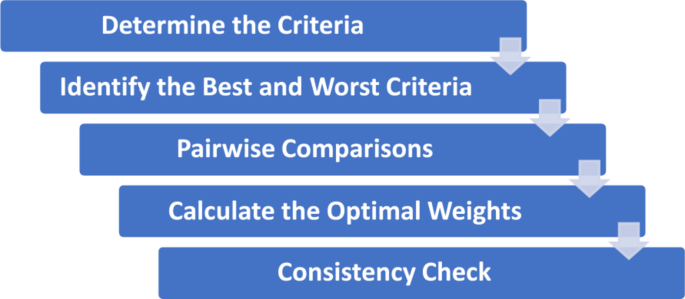
Data analysis using BWM method
Sample Calculation: 01

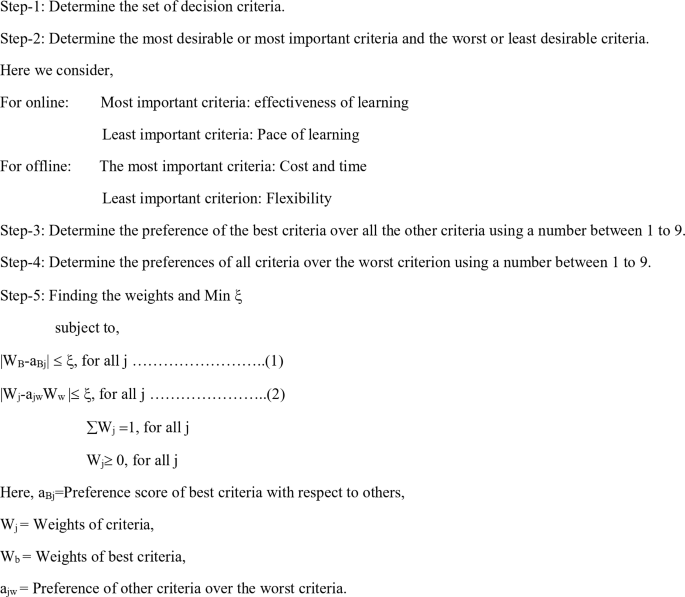
Table 1 outlines the determination of the best criterion for online learning by comparing “Effectiveness of Learning” against other criteria. It lists preference scores ranging from 1 to 9, reflecting the degree of importance each criterion has relative to “Effectiveness of Learning.” The high score assigned to “Technological Criteria” (9) indicates significant perceived impact. Lower scores, like those for “Cost and Time,” suggest these criteria were seen as less critical. The table helps highlight which factors are prioritized by participants in an online learning context.
Table 2 displays the identification of the best criterion for offline learning, with “Cost and Time” being compared against other factors. Preference scores indicate that “Flexibility” (score of 9) is seen as the most important after “Cost and Time,” whereas “Practicality” receives a lower preference score. The table demonstrates a distinct pattern where time and financial considerations dominate decision-making in offline settings. This reflects participants’ recognition of tangible costs associated with traditional education. The scores also suggest varying levels of importance for different factors in offline learning.
Table 3 lists the preferences of other criteria in relation to the least important criterion, “Pace of Learning,” for online learning. High scores, such as those for “Effectiveness of Learning” (9), reveal the significant value placed on impactful learning outcomes. Lower scores for “Cost and Time” show it is considered less critical in the online setting.
Table 4 shows the preferences of criteria relative to “Flexibility,” identified as the least important criterion in the offline context. “Cost and Time” receives the highest score (9), indicating that participants see it as the most crucial factor. The table reveals that while “Flexibility” might be less valued offline, other factors like “Interaction” and “Concentration” are still prioritized.
Table 5 provides the calculated weights for each criterion in the online learning context, using BWM to determine relative importance. The highest weight is assigned to “Effectiveness of Learning” (0.338), showing its priority over other criteria. Weights for factors like “Pace of Learning” and “Technological Issues” are lower, suggesting less emphasis in the online environment. The table shows a balanced approach to weighing cognitive, practical, and logistical aspects of learning. These calculated weights are crucial for understanding which areas should be targeted for improvement in online education.
Table 6: Lists the weights assigned to criteria for offline learning, indicating how participants prioritize different factors. “Cost and Time” has the highest weight (0.340), while “Flexibility” is the least weighted factor. The table reflects a greater emphasis on practical and logistical considerations in traditional learning. Weights for factors like “Practicality” suggest that hands-on experiences are valued offline, compared to lower weights for “Technological Issues.” This distribution provides a clearer picture of the key concerns influencing offline education.
Figure 2 is the graphical representation of the results for the weights of different criteria in online learning, determined using the Best Worst Method (BWM). The bar chart highlights “Effectiveness of Learning” as the most important factor, with the highest weight, while criteria such as “Pace of Learning” and “Technological Issues” have lower weights, indicating they are considered less critical by participants. This graphical representation helps visualize the varying levels of importance assigned to each criterion, identifying key strengths and areas for improvement in online education.

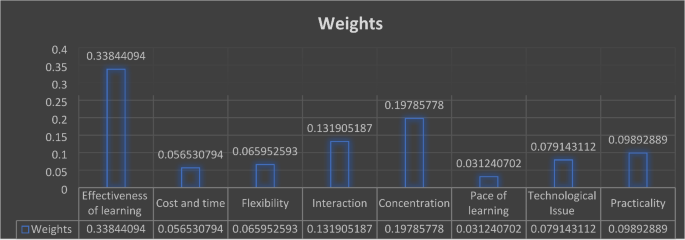
Weights of criteria for online.
Figure 3 provides a graphical representation of the weights of criteria for offline learning, based on BWM analysis. The bar chart shows that “Cost and Time” is the most heavily weighted factor, indicating its significance in traditional education, while “Flexibility” has the lowest weight. The graphical representation illustrates that practical considerations like “Practicality” and “Concentration” are more prioritized in offline settings compared to other criteria. This visual summary allows for a straightforward comparison with the results shown in Fig. 1, demonstrating the differing priorities between online and offline learning environments. The figure effectively conveys the participants’ evaluations, emphasizing the distinctions in how learning factors are valued across modalities.

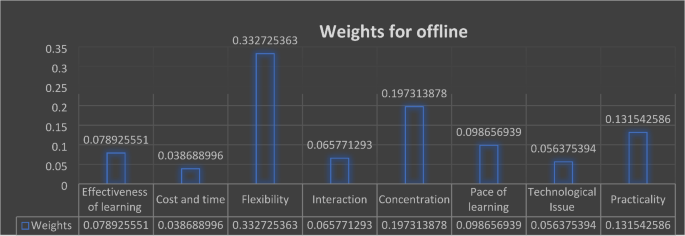
Weights of criteria for offline.
Consistency check
Table 7 shows the consistency check results for online learning, confirming that the pairwise comparisons meet an acceptable consistency ratio. The input-based consistency ratio (CR) is 0.1645, indicating that participant evaluations are within a reasonable range. The associated threshold of 0.362 validates the reliability of the results. This table helps ensure that the comparisons made are not arbitrary but based on consistent judgment. Such consistency strengthens the credibility of the weight calculations for online learning criteria.
Table 8 displays the consistency check for offline learning, with an input-based CR of 0.152, meeting the same threshold (0.362). This demonstrates that offline learning criteria comparisons also exhibit an acceptable level of consistency. The results validate the reliability of the participants’ evaluations in an offline context. Consistency checks like this help identify any deviations that may affect decision-making quality. The table confirms the robustness of the results derived from the BWM process.
Sum of criteria weight using BWM
Table 9 summarizes the total weight sums for each criterion across all participants, specifically for the online learning context. “Cost and Time” and “Effectiveness of Learning” show substantial variation in total weight sums, reflecting different participant perspectives. The cumulative values help in understanding common priorities and disparities among the participants’ responses. The table provides a collective view of how various criteria are evaluated in online education. Such aggregation enables a comprehensive assessment of learning factors across different participants.
Table 10 presents the aggregated weights for offline learning, indicating the sum of weights for each criterion as judged by all participants. “Technological Issues” and “Concentration” have the highest weight sums, showing participants’ concerns with technical barriers and focus in offline learning. The table illustrates the extent to which each criterion impacts overall learning effectiveness in a traditional context. Differences in weight sums highlight varying levels of significance assigned to each factor. This consolidated data helps compare the offline learning priorities against online ones, guiding targeted improvements.
Ranking of criteria using BWM
Table 11 ranks the criteria for the online context based on their average weight and percentage using the BWM method.
In Table 11, the ranking of criteria for online learning reveals that Cost and Time is the most critical factor, representing 25.74% of the weight. This high priority indicates that affordability and time efficiency are essential for students when considering online learning. The emphasis on reducing expenses (such as transportation and material costs) and saving time from commuting and structured class hours highlights the value students place on the financial and logistical benefits of online education. The ability to minimize these commitments makes online learning particularly appealing, allowing students to balance their studies with other financial and time constraints.
Following closely, Flexibility, with a weight of 19.38%, ranks as the second most important criterion for online learning. Flexibility here encompasses the convenience of learning from any location and at any time, which enables students to fit education around other responsibilities. This adaptability is especially beneficial in contexts like Bangladesh, where technological access varies, and students often juggle personal, educational, and professional obligations. The ability to control their schedule without the rigidity of traditional classrooms is a significant advantage for online learners. Mid-ranking criteria include the Pace of Learning (12.56%) and Concentration (12.31%). The weight assigned to the pace of learning indicates that students value being able to adjust the speed of their learning. Many students find the self-paced nature of online learning appealing, as it allows them to tailor the speed of their studies to match their comprehension and schedules. Similarly, concentration, while also significant, suggests that students recognize the criteria of maintaining focus in an online environment, where distractions are more prevalent, and a structured environment may be lacking. These results indicate that an effective online setup should be mindful of students’ need to manage distractions while maintaining a pace conducive to engagement.
Finally, lower-ranking criteria such as Technological Issues (5.27%) and Practicality (7.27%) reflect lesser concern in the online setting, as students seem to prioritize cognitive and logistical benefits over hands-on learning elements. The low weight for technological issues suggests that students are less concerned with technical criteria or have found ways to manage them, while practicality, which involves experiential learning, is naturally less emphasized in online formats due to the limitations of virtual platforms.
In Table 12, which ranks criteria for offline learning, the results differ significantly, highlighting the distinct priorities in traditional settings. Technological Issues top the list with a weight of 19.25%, emphasizing the importance students place on reliable technology even in offline settings, likely due to the limited digital resources and support in these environments. This high ranking suggests that any technological barriers, even minimal, can heavily impact students’ learning experience in offline contexts.
Concentration is the second highest priority in offline learning (18.47%), underscoring the value of an immersive, distraction-free environment, which traditional classrooms are better equipped to provide. The emphasis here suggests that students view offline environments as better suited to sustained focus and engagement, an advantage that direct, face-to-face learning provides. Following these is Practicality (15.64%), which reflects the hands-on, experiential value offline learning offers, especially important in fields like engineering. The ability to engage in practical, tactile learning experiences strengthens students’ skills and comprehension, elements challenging to replicate online. Effectiveness of Learning (14.46%) and Interaction (13.98%) rank fourth and fifth, respectively, demonstrating that students value direct engagement with instructors and peers, which facilitates deeper understanding and immediate feedback.
In contrast, Cost and Time and Flexibility hold the lowest weights, at 5.21% and 4.16% respectively, indicating that logistical factors are less of a concern in offline education. This disparity between online and offline priorities provides essential insights: while online learning emphasizes flexibility and affordability, offline learning values immersive and interactive experiences. The findings suggest that both online and offline modalities have unique advantages, and future learning models could benefit from blending these priorities to enhance educational effectiveness across different contexts.
For online learning, the weights highlight “Effectiveness of Learning” as the most prioritized criterion, emphasizing its critical role in improving educational outcomes, while “Technological Issues” received a lower weight, reflecting lesser perceived challenges in this area. These outputs indicate that targeted efforts to enhance the effectiveness of online learning tools will yield significant benefits. In offline learning, “Cost and Time” emerged as the most heavily weighted factor, demonstrating its importance in resource-constrained environments like Bangladesh, where traditional classroom settings still dominate. “Flexibility” was the least weighted criterion, indicating a lower emphasis on adaptable schedules in offline contexts.
Additionally, graphical representations have been included to visualize these weight distributions for better clarity. Each weight and ranking have been interpreted in the context of the participants’ responses, linking them to practical implications for educational policy and planning. This approach ensures that even readers unfamiliar with BWM can understand the relevance and application of the findings.
Sensitivity analysis
Sensitivity analysis in the Best Worst Method (BWM) is essential for evaluating the robustness of judgments by analyzing the impact of fluctuations in criterion weights on the final outcome. It aids in pinpointing the paramount criteria, guiding decision-makers to focus on critical matters. The approach increases confidence in the stability and validity of results, despite variations in assessments. It also enhances risk management by clarifying the impacts of ambiguity. Sensitivity analysis enables the exploration of many possibilities through “what-if” scenarios. Ultimately, it ensures that the MCDM process is robust, reliable, and validated.
Sensitivity analysis for online learning
The weight of “C1-Cost and Time” has been adjusted in this study from 0.1 to 0.9, examining its impact on other identified criteria in online learning. Upon altering the weight of the “C1-Cost and Time” problem from 0.1 to 0.9, the proportional significance of each challenge is encapsulated in Table 13. Consequently, Table 14 illustrates the hierarchy of the criteria rated.

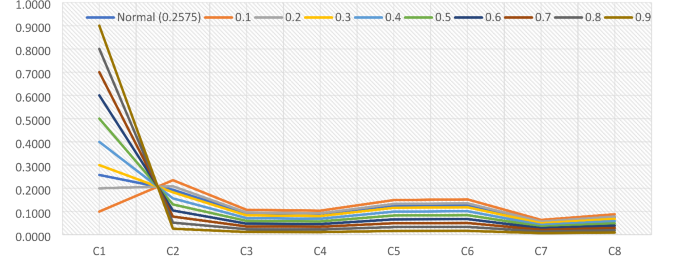
Graphical representation of weights of the criteria of online education during sensitivity analysis.
Simultaneously, the scales of further criteria are modified. Table 14 displays a ranking of the identified criteria associated with the online learning, derived from sensitivity analysis. Table 14; Fig. 4, and Fig. 4 illustrate the findings of the sensitivity study, indicating that the factor designated as “C1-Cost and Time” consistently receives the highest rating. In contrast, the challenge labeled “C7-Technological Issues” routinely attains the lowest grade. Figures 4 and 5 illustrate the changes in weight and ranks that occurred throughout the sensitivity testing. Sensitivity study substantiates the claim that outcomes generated by the Best Worst Method (BWM) demonstrate consistency, absence of bias, and enhanced trustworthiness.

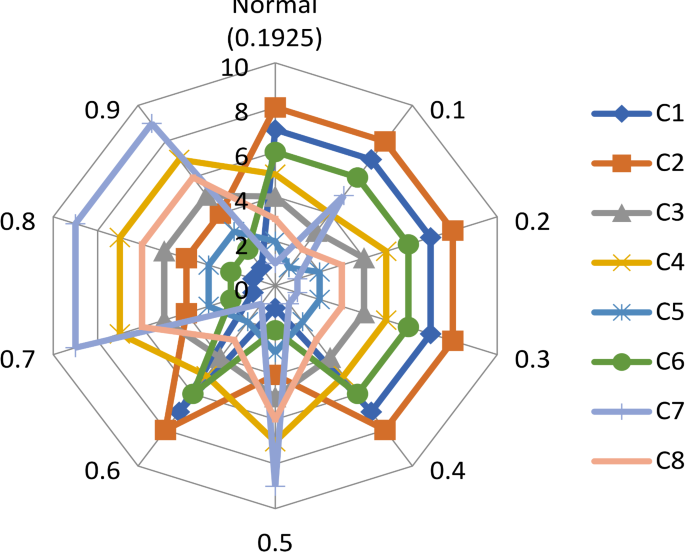
Spider chart of ranking of the online learning criteria after sensitivity analysis.
Stability in sensitivity analysis ensures that criteria like cost, internet accessibility, and flexibility maintain their priority rankings even when input data or assumptions slightly change. For policymakers, this stability validates investments in online infrastructure, such as improving internet access or subsidizing digital devices, ensuring these initiatives have a consistent impact. Education planners can confidently design online learning strategies knowing these factors will reliably enhance accessibility and student engagement in Bangladesh.
Sensitivity analysis for offline learning
The similar procedures of sensitivity analysis have been carried out for offline learning system. Here the weight of “C7-Technological Issues” has been modified from 0.1 to 0.9, analyzing its influence on other specified criteria in online learning. By adjusting the weight of the “C7-Technological Issues” issue from 0.1 to 0.9, the relative importance of each criterion is summarized in Table 15. Thus, Table 16 delineates the hierarchy of the assessed criteria.
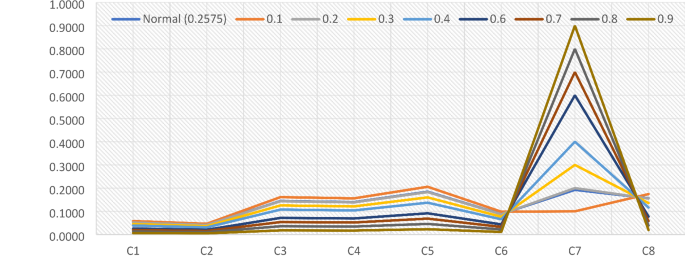
Graphical representation of weights of the criteria of offline education during sensitivity analysis.
The criterion scales are concurrently adjusted. Table 16 presents a rating of the found factors related to online learning, obtained via sensitivity analysis. Table 16; Figs. 6, and 7 present the results of the sensitivity analysis, demonstrating that the variable labeled “C7-Technological Issues” regularly attains the highest rating. Conversely, the challenge designated “C2-Flexibility” consistently receives the lowest rating. Figures 6 and 7 depict the variations in weight and rankings observed during the sensitivity testing. The sensitivity research confirms that the results produced by the Best Worst Method (BWM) for offline learning also exhibit consistency, lack bias, and possess increased reliability.

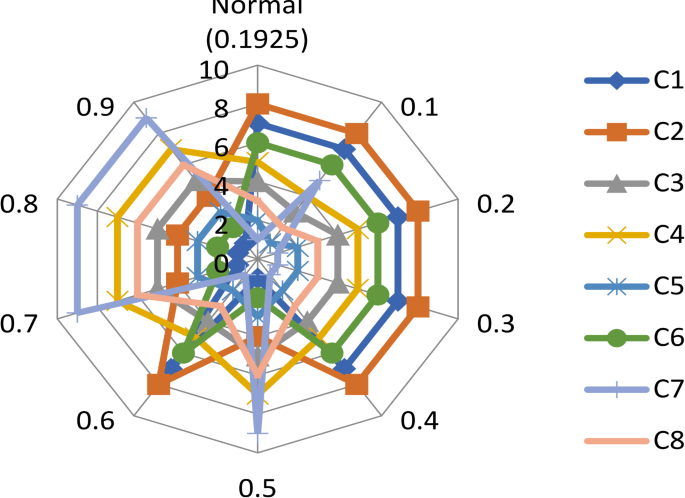
Spider chart of ranking of the offline criteria after sensitivity analysis.
For offline learning, stability in sensitivity analysis confirms the importance of criteria like practical engagement, structured environments, and student-teacher interaction, regardless of minor variations in assumptions. This reliability supports policymakers in prioritizing investments in laboratory facilities, hands-on training, and teacher development. Education planners can trust that focusing on these aspects will consistently improve the effectiveness of offline education for engineering students in Bangladesh.
link