


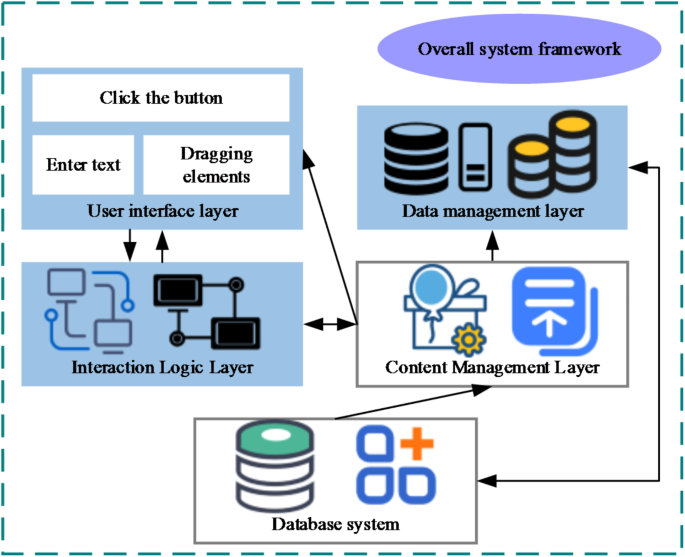
Experimental environment and parameters setting
Table 1 exhibits the experimental environment used in this study, including hardware configuration and software configuration:
Table 2 shows in detail the parameter settings involved in the experiment, ensuring the standardization and reproducibility of the experimental conditions:
Performance evaluation
This study employs the following indicators (promotion rate of learning effect, system response time, user satisfaction, error rate, and interactive experience score) to evaluate the proposed interactive system’s performance. The promotion rate of learning effect measures the percentage change in grades before and after learning in different educational contents and age groups. System response time is based on the system’s response time under various operations and load conditions. User satisfaction is assessed from the perspectives of children, educators, and parents. Error rate refers to the operation error frequency of diverse modules in the system. The interactive experience score is based on different modules, user types, interactive fluency, and intuitive scores. The improvement of the learning effect is shown in Fig. 4:

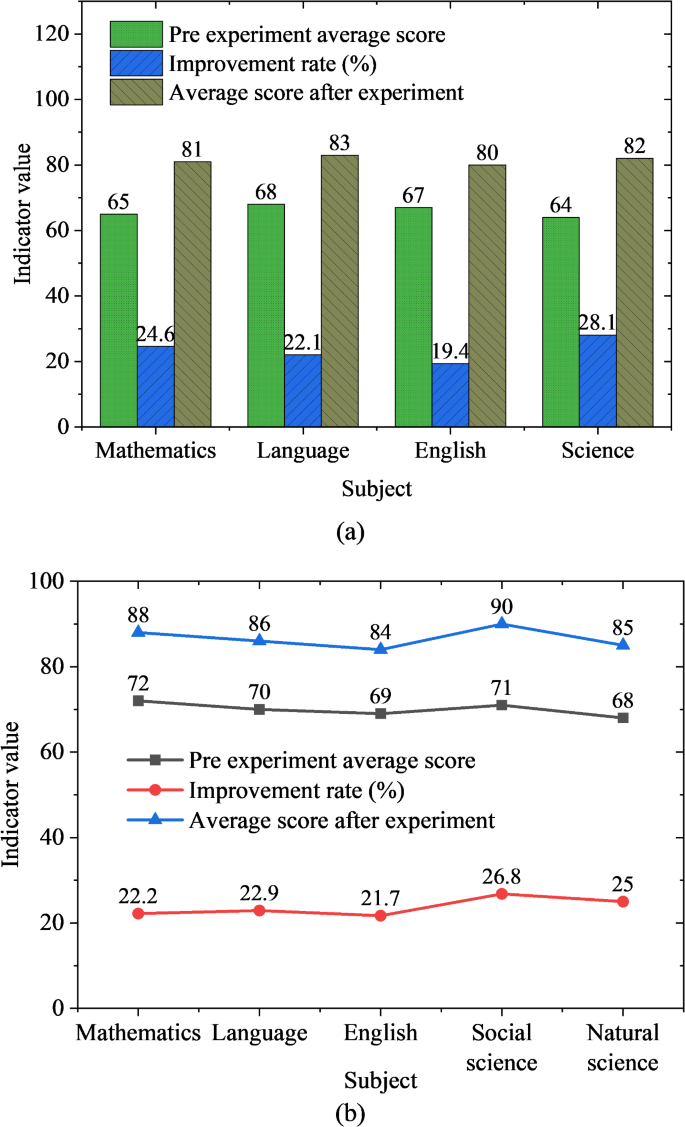
The improvement rate of children’s learning effect at different ages (a. Grades 1–3; b. Grades 4–6).
In Fig. 4, within grades 1–3, science subjects exhibit the highest promotion rate, reaching 28.1%. This suggests that the learning system is particularly effective in providing experimental and practical content, aiding younger students in better comprehending abstract scientific concepts. In grades 4–6, the promotion rate of social science is the highest, at 26.8%. For students of this age, the system may effectively enhance their understanding and interest in social science through interactive content and case studies. Mathematics and Chinese demonstrate a consistent promotion rate in both grade groups, indicating the learning system’s wide applicability and effectiveness in these fundamental subjects. The promotion rate of English is slightly lower in grades 1–3, possibly due to the need for more practice and immersion in the language environment in language learning.
Further statistical analysis on the improvement of learning effects is outlined in Table 3:
According to the statistical analysis results in Table 3, the improvement in learning effects across all subjects is significant in different grade groups. The p-values from the t-test are all less than 0.01, indicating that the system’s impact on learning effects is statistically significant. Cohen’s d is used to measure the effect size. In the grade groups 1–3, the effect size for science (d = 0.67) is large, suggesting that the learning system has a significant impact on improving learning effects in this subject. Mathematics (d = 0.56) and Chinese (d = 0.53) also exhibit moderate effect sizes, confirming the system’s effectiveness in these subjects. An effect size greater than 0.5 is generally considered to represent a moderate or stronger effect, illustrating that the application of the learning system has a tangible positive impact on these subjects.
In the grade groups 4–6, the effect size for social science (d = 0.62) is slightly higher than that for mathematics (d = 0.58) and English (d = 0.50). This result can be explained by the differences in content complexity and students’ interest in various subjects. For instance, social science may rely more on interactive content and case analysis, making it more responsive to system optimization. Science and social science exhibit more pronounced improvements, particularly in the grade groups 1–3 and 4–6, with the improvement rates and effect sizes being notably significant. The characteristics of these subjects make them more conducive to enhancing students’ understanding of abstract concepts when using an interactive learning system. In contrast, English shows relatively weaker improvement in the grade groups 1–3 (d = 0.50), which may be related to the long-term nature of language learning and students’ reliance on a language-rich environment. Overall, the learning system demonstrates positive improvements in learning effects across most subjects and grade groups, and the effect size analysis validates this finding.
Figure 5 presents the system response time, comparing the performance of the proposed system with similar HCI systems for children’s education from the references49 and 50.

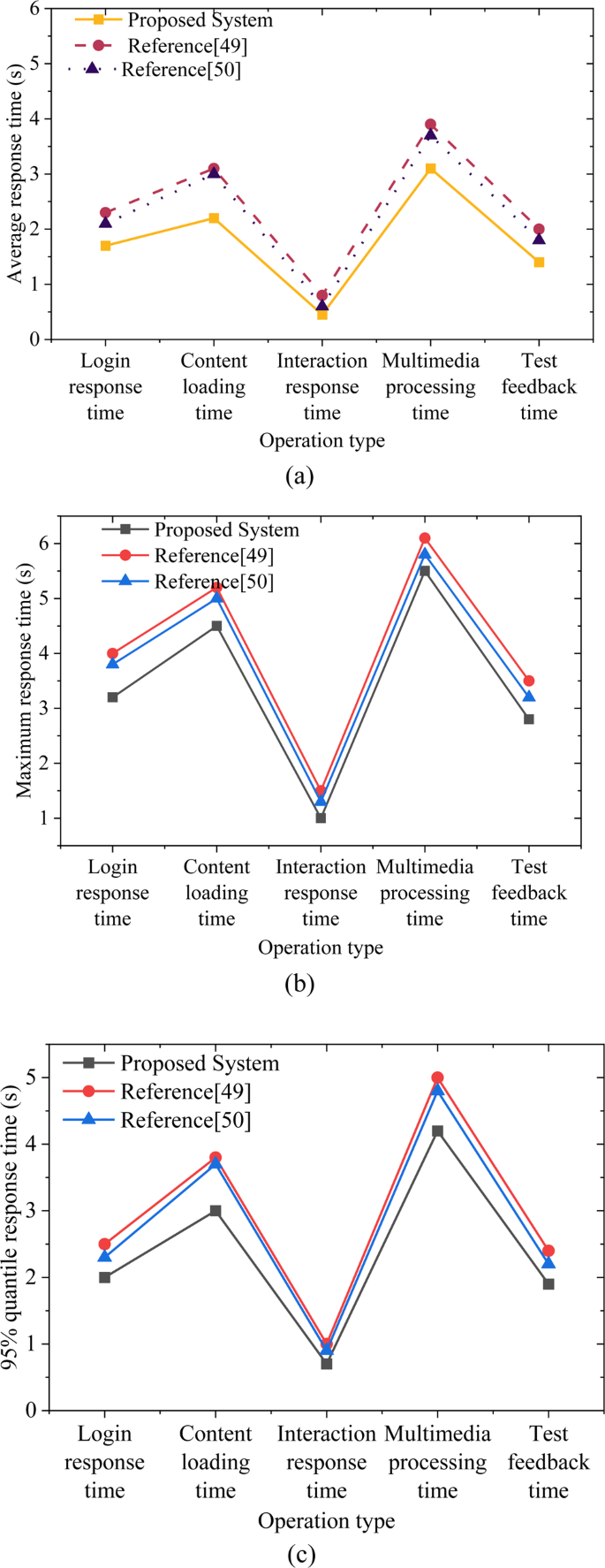
System response time situation (a. Average response time; b. Maximum response time; c. 95% quantile response time).
Figure 5 shows that the proposed system exhibits significant advantages in multiple response time indicators compared to the systems in the references49 and 50. First, regarding login response time, the proposed system’s 1.7 s is significantly lower than the 2.3 s reported in reference49 and the 2.1 s in reference50. This indicates that the proposed system responds to user login requests more quickly, reducing waiting times during system startup and enhancing the initial user experience. Especially in educational systems, fast login times can improve system acceptability and user satisfaction. Second, in terms of content loading time, the proposed system’s 2.2 s is also notably better than the 3.1 s in reference49 and 3.0 s in reference50. This means that the proposed system can load educational content more efficiently, particularly when dealing with large multimedia resources, reducing user wait times and improving learning efficiency. Furthermore, considering interaction response time, the proposed system’s 0.45 s is much lower than the 0.8 s in reference49 and 0.6 s in reference50, indicating that the proposed system has a faster response time for user interactions. Quick interaction response times are crucial for enhancing the interactivity and user experience of educational systems, especially in educational settings where students and teachers need rapid feedback. Regarding multimedia processing time, the proposed system’s 3.1 s is faster than the 3.9 s in reference49 and 3.7 s in reference50, demonstrating stronger processing capabilities. The system can quickly handle multimedia content such as audio and video, reducing delays caused by loading large files and improving the efficiency of presenting instructional content. Finally, in terms of test feedback time, the proposed system’s 1.4 s is better than the 2.0 s in reference49 and 1.8 s in reference50, suggesting that this system provides quicker feedback on students’ test results. This improves the timeliness of feedback during the learning process and helps students adjust their learning strategies more quickly.
Overall, the proposed system outperforms the systems in reference49 and reference50 on all key indicators, particularly in terms of response time and processing speed. These advantages significantly enhance the user experience and the efficiency of the educational system. This improvement is mainly attributed to optimized backend processing mechanisms, efficient resource management, caching strategies, and smoother user interaction design. All of these enable the system to provide fast and stable services across different usage scenarios, thus improving the effectiveness and quality of educational activities. The probability of system errors is suggested in Fig. 6.

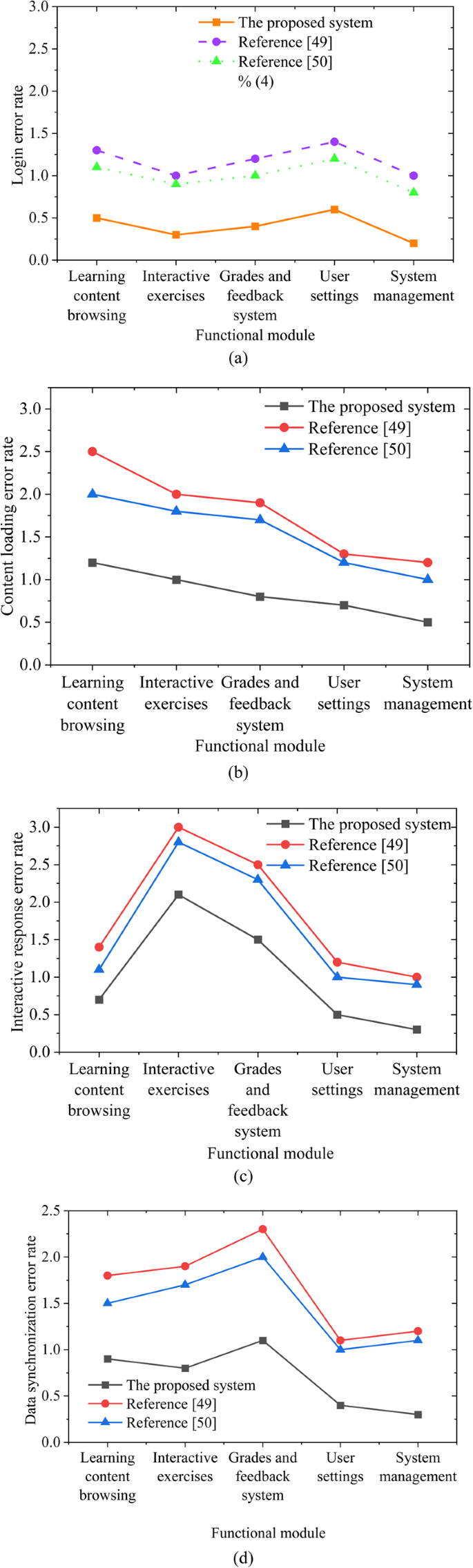
Error rates of the HCI learning system (a. Login error rate; b. Content loading error rate; c. Interaction response error rate; d. Data synchronization error rate).
The data in Fig. 6 indicates that the proposed system is superior to the references49 and 50 in the error rate of all functional modules, particularly in login, content loading, interaction response, and data synchronization. First, regarding the login error rate, the proposed system exhibits significantly lower error rates in the “learning content browsing,” “interactive exercises,” and “grades and feedback system” modules compared to references49 and 50. This indicates that the proposed system has better stability during the user login process, reducing difficulties encountered by users when logging in. In contrast, the error rates in references49 and 50 are generally higher, especially in the “user settings” and “system management” modules, where the proposed system also shows relatively lower error rates, reflecting the optimized system architecture.
In terms of content loading error rates, the proposed system shows lower error rates in the “learning content browsing” and “interactive exercises” modules than the systems in references49 and 50. Particularly in the “grades and feedback system,” the proposed system performs exceptionally well. The higher error rates in references49 and 50 may be related to the complexity of the content-loading modules and the network environment.
For interaction response error rates, the proposed system has a lower error rate in the “learning content browsing” module compared to references49 and 50, indicating higher accuracy and smoother interaction responses. Especially in the “interactive exercises” and “grades and feedback system” modules, the proposed system continues to outperform both reference systems. The higher interaction response error rates in references49 and 50 may be attributed to insufficient optimization of their system’s response speed and user interface design.
Finally, in terms of data synchronization error rates, the proposed system performs better than references49 and 50 across all modules, with the most significant differences observed in the “learning content browsing” and “interactive exercises” modules. This suggests that the proposed system has stronger stability in real-time data updates and synchronization, better handling the synchronization of multiple users and data streams.
In summary, the proposed system shows remarkable advantages over the systems in references49 and 50 in terms of performance across all functional modules, especially in reducing error rates. Key factors contributing to the system’s advantages include optimized system design, data processing, interaction design, and real-time synchronization capabilities, significantly enhancing the user experience. Especially in educational applications, the system’s high reliability and low error rates play a critical role in improving learning effects.
Figure 7 presents the survey results regarding different users’ satisfaction with the system’s use.

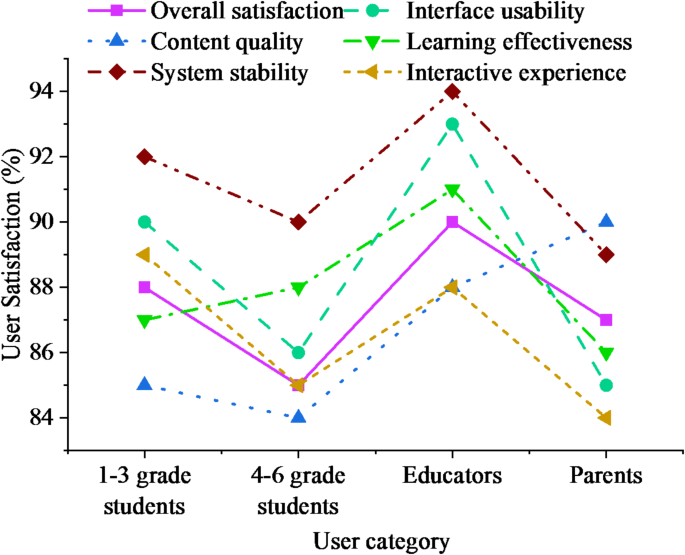
Analysis of user satisfaction survey results.
In Fig. 7, the overall satisfaction of educators is the highest, reaching 90%. This may be attributed to their ability to better assess the effectiveness of the learning system in teaching, particularly in terms of convenience in teaching management and academic guidance. Students’ satisfaction is relatively lower, especially for students in grades 4–6, which could be related to the complexity of the learning content and the increasing system requirements as grade levels advance. Educators report the highest satisfaction with the system’s interface usability, at 93%, indicating that the interface design aligns with their operational habits, enabling them to work more efficiently during use. In contrast, parents rate the interface usability slightly lower, at 85%, which may be due to their less frequent use of the system and lower familiarity with the interface design. However, parents rate the content quality the highest, at 90%, reflecting their strong emphasis on educational content, particularly the system’s positive impact on improving their children’s academic abilities. For students in grades 4–6, their satisfaction with learning effects is 88%, showing that the system effectively delivers instructional content that meets the learning needs of older students. These varied feedbacks suggest that the system’s design meets the diverse needs of different users and has substantial educational value, especially in enhancing academic performance and fostering learning motivation.
Discussion
The experimental results of this study indicate a significant improvement in the learning effect of students in grades 1–3 and 4–6 after using this learning system. This finding aligns with the research of Yousef51, who demonstrated that using technology-assisted learning tools could effectively enhance students’ learning motivation and grades. Furthermore, the subject-specific promotion demonstrated the system’s success in content adaptability, supporting Liu et al.‘s52 argument that personalized learning paths could remarkably enhance learning efficiency and outcomes. The system’s response time surpassed that of many existing educational technology solutions, according to Tessema & Cavus53, who highlighted the system’s response time as a key factor influencing user satisfaction and continuous usage willingness. The study’s data reveals that the average response time of different operation types falls within the acceptable range for users. The user satisfaction survey’s results and the system’s error rate data complement each other, as low error rates correspond to high user satisfaction. This finding was consistent with the research of Almaiah & Alyoussef54, who emphasized that system reliability was crucial to ensuring the effectiveness of educational resources.
As AI ethics receive increasing attention, especially regarding the challenges of privacy protection, data security, and algorithmic bias in educational settings, this study offers an in-depth exploration of HCI and AI technologies within educational technology. meanwhile, it provides valuable insights for future discussions on AI ethics in education. Furthermore, with the rapid development of personalized and adaptive learning technologies, how to utilize emerging technologies to help students from different backgrounds and with varying abilities achieve personalized learning has become an important research direction in education. This study, through its exploration of adaptive learning systems, demonstrates how HCI technology can respond to differentiated student needs, making it highly relevant for practical application.
It can be found that this study demonstrates the performance of the interactive learning system through various evaluation indicators, including improvements in learning effects, system response time, and error rates, all showing positive results. However, there are some limitations in the current research that need further improvement in future studies. First, the sample size and diversity are somewhat limited, as the study primarily focuses on a single educational institution, which may constrain the generalizability of the findings. Future studies should consider expanding the sample size and including participants from various educational backgrounds, regions, and age groups to verify the system’s effectiveness in different contexts. Second, the evaluation period in this study is relatively short and may not fully reflect the system’s effects over prolonged usage. Future research could employ longitudinal designs to track the system’s performance over a longer period to gain a deeper understanding of its sustained impact and identify potential areas for improvement. Third, while this study assesses the system’s performance indicators (e.g., response time and error rates) under controlled conditions, the system’s performance in real-world environments may vary due to network instability or differing hardware conditions. Therefore, future studies should evaluate the system in real-world environments to ensure its stability and reliability under varying conditions. Moreover, although the system receives positive feedback from educators and parents, there are notable differences in satisfaction among students of different grade levels, especially with older students providing relatively lower feedback. This suggests that the system’s usability and learning content may need adjustments based on various age groups. Future research should further explore the factors influencing user satisfaction across diverse groups and refine the system experience accordingly.
link