A strategic mindset predicts and promotes effective learning and academic performance
Study 1: nation-wide survey of adolescents
We tested the role of a strategic mindset in students’ use of effective learning strategies and academic achievement amidst the changes and difficulties wrought by the COVID-19 pandemic. We conducted a nation-wide survey of adolescents in Singapore, assessing the relations among their strategic mindset at the beginning of the 2020 academic year, their reported use of effective learning strategies in the middle of the academic year (amidst the challenging, pandemic-necessitated learning transitions from in-person to online and back to in-person lessons), and their final exam performance collected at the end of the school year. We predicted that students’ strategic mindset would prospectively and positively predict their use of learning strategies that are scientifically proven to be effective for mastery (e.g., relating new knowledge to their existing knowledge, identifying the important content to study), and consequently, that these students would perform better on their year-end, final exams.
We surveyed 5185 late primary through secondary students (across 5 grades: approximately 11–12 through 15–16 years old) from 270 classes across 29 Singapore public schools. A detailed demographic breakdown is provided in Supplementary Table 1 in the Supplementary Information (SI).
At the beginning of the academic year (February to March), we assessed students’ strategic mindset using a 5-point response scale (1=Never, 5=Most of the time). As mentioned earlier, people with a strategic mindset use moments of difficulty or unproductivity as cues to ask themselves strategy-eliciting questions. Therefore, the strategic mindset scale items take the form of how often students ask themselves such strategy-eliciting questions, especially when they encounter difficulty or unproductivity. Examples of strategic mindset scale items include: “When something is very hard for you, how often do you ask yourself: ‘What can I do to make myself better at this?’” and “Whenever you feel like you are not making progress, how often do you ask yourself: ‘Is there a different way I can do this?’”
In the middle of the academic year (July–August), students experienced a month-long learning transition from in-person classes to fully online learning, and then back to in-person classes. Shortly after they returned to in-person classes, we asked students to report how much they had been using various effective learning strategies during learning. We used the well-established Learning and Study Strategies Inventory (LASSI) 3rd edition Skill subscale4, which included items such as: “I summarize what I’m studying in my own words,” “I try to connect what I am studying to what I already know,” and “When my teacher is teaching a lesson in class, I am able to pick out the important information.” In the “Methods” section, we describe each of our scale measures in further detail, along with their scale reliabilities, for all studies. At the end of the school year, with parental consent and students’ assent, we obtained students’ final exam performance results.
To analyze the effect of a strategic mindset on learning strategies and on final exam performance, we used mixed-effects models using the lme4 package in R, including random effects of level and school, and of class nested within level and school. This is because students are in only one class, classes are nested within grades and within school, and grade-levels and schools are crossed (see Supplementary Note 1 for further details about the analytical approach and explanation). For mediation analyses, we used the Process macro model 433 with 1000 bootstrap resamples.
As hypothesized, students’ strategic mindset prospectively and positively predicted the degree to which they reported using effective learning strategies amidst the challenging mid-year learning transitions (mixed effects model regression coefficient b = 4.07, [3.73, 4.41], t = 23.45, p < 0.001); and in turn, students who used effective learning strategies to a greater degree performed better on their final exams (mixed effects model regression coefficient b = 0.21 [0.19, 0.24], t = 16.83, p < 0.001).
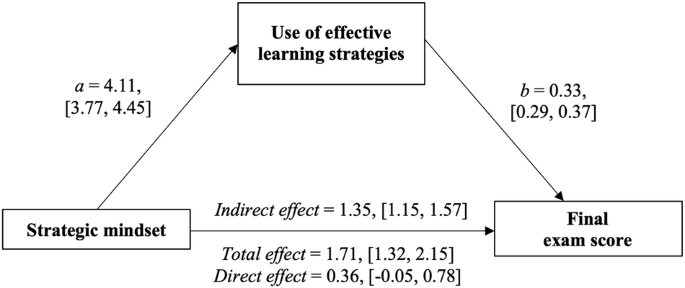
We found the predicted indirect effect of a strategic mindset on final exam performance, mediated by greater use of effective learning strategies (indirect effect estimated with 1000 bootstrap resamples = 1.35, [1.15, 1.57]; Fig. 1). When accounting for the indirect effect, the direct effect of a strategic mindset on final exam performance was diminished. This is consistent with what we might expect when students simply ask themselves, “What can I do to make myself better at this?” but do not actually apply task-appropriate, effective strategies.
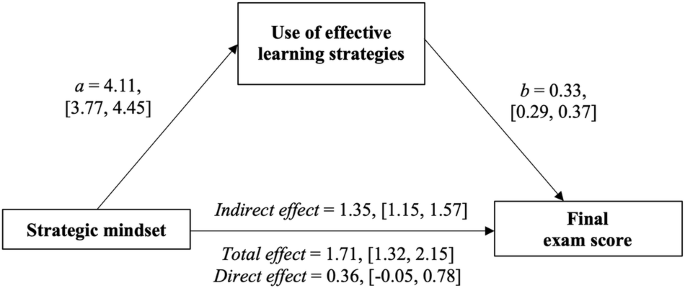
The figure represents results from a simple mediation model. The model shows the relation between students’ strategic mindset at the beginning of the academic year and their year-end, final exam performance, mediated by their reported use of effective learning strategies in their classes. Unstandardized coefficients (represented by the small letters) and their 95% confidence intervals (in square brackets) were bootstrapped 1000 times.
As a robustness test, the observed indirect effect was still significant when controlling for students’ prior year final exam performance (indirect effect with prior performance covariate = 0.28, [0.19, 0.37])—even though their prior performance was highly correlated with their current final exam performance at r = 0.85, on average across cohorts. Our results were also robust when controlling for students’ growth mindset of intelligence, which is a well-known mindset construct that reliably predicts academic achievement, as described earlier (indirect effect with growth mindset as a covariate = 1.16, [0.97, 1.36]).
Importantly, this mediated psychological process model was robust across every grade level (Table 1)—including the crucial Primary 6 and Secondary 4 years, when students in Singapore sit for high-stakes, standardized national exams. These national exams are the Primary School Leaving Examination (PSLE) and the GCE O-Level and N-Level Examinations taken at the end of Secondary School, respectively (the “Methods” section provides further details about these exams and how they are scored). Unlike school-specific exams, the PSLE and GCE Examinations are administered in a coordinated, consistent manner at the same time across schools nation-wide to all students within the same cohort, which makes individual students’ performance scores comparable across classes and schools at a national level. These national exams are important for students’ long-term educational trajectories. That is, performance on these exams determines whether they qualify to proceed to the next educational level, the schools that they are eligible to enroll in, and the subjects that they can study.
To get a sense of the practical effect size, Supplementary Table 2 provides a breakdown of the raw performance scores by education level, organized by type of exam. A 1-point increase on the 5-point strategic mindset scale, acting through students’ increased use of effective learning strategies, corresponded to scoring an average of 5.9 raw points higher on students’ national Primary School Leaving Examinations at the Primary 6 level. Likewise, a 1-point difference on the strategic mindset scale corresponded to scoring about 0.5 points lower on the Secondary 4 O- and N-Level Examinations, where lower scores reflect higher academic achievement.
We also observed a significant, positive total effect of a strategic mindset on exam performance. Aggregating across levels and schools, students who scored higher on a strategic mindset at the beginning of the year performed better on their final exams (mixed effects model b = 1.03, [0.77, 1.29], t = 7.78, p < 0.001). A 1-point increase on the strategic mindset scale corresponded to scoring an average of 1.03 percentage points (i.e., out of 100) higher on the final exams.
To summarize our first study, we found the hypothesized relation between a strategic mindset, students’ reported use of effective strategies during learning, and their academic performance. This psychology seems to be robust across a range of educational levels, types of exams (both school-specific and standardized, high-stakes national exams), and even when controlling for the aforementioned covariates that tend to be relevant to academic achievement. Our results underscore the important, potentially generalizable effects of a strategic mindset on effective learning strategy use, and in turn, real-world performance outcomes.
Study 2: college student replication study
To test the robustness and further generalizability of our findings to older students, we replicated our findings with 1037 final-year Singapore public university undergraduates (Mage = 23.9 years, SDage = 1.2, range: 21–30 years. 59.4% females) in a pre-registered study. Participating students were recruited from various fields and Departments across the university (e.g., Business, Arts and Social Sciences, Engineering, Science, Design). The cross-sectional survey ran from March 2021 to mid-May 2021, when students were enrolled in online, in-person, and/or hybrid classes that were structured to accommodate the pandemic. These educational changes presented generally unfamiliar challenges to students, which provided an opportunity for us to study students’ self-regulated strategy use amidst such circumstances.
Participating university students completed measures of their strategic mindset using the strategic mindset scale for adults23 and reported how much they used various learning strategies known to be effective for learning (using the LASSI 3rd edition Skill subscale for college students4; example item: “I try to find relationships between what I am learning and what I already know.”). With students’ consent and as our performance outcome of interest, we obtained from the university their 5-point end-of-semester GPAs (also known as their “Cumulative Average Points”) aggregated across all their classes for that academic semester.
Because this was a cross-sectional survey administered at a single time point, we used linear regression analyses to estimate the effect of a strategic mindset on students’ reported use of effective learning strategies, and in turn, their end-of-semester GPAs at the individual student level. Again, we observed that college students’ strategic mindset predicted their reported use of effective learning strategies in their classes (b = 5.56 [4.81, 6.31], t = 14.47, p < 0.001); and these students who reported using effective learning strategies to a greater degree attained higher GPAs at the end of that same semester (b = 0.01 [0.01, 0.01], t = 6.36, p < 0.001).
To test mediation, we used the lavaan package in R (Version 0.6-1534) with 1000 bootstrap resamples. We observed the predicted, significant indirect effect of a strategic mindset on semester GPA, mediated by students’ reported use of effective learning strategies during learning (indirect effect estimated with 1000 bootstrap resamples = 0.05 [0.04, 0.07]; Fig. 2). Like Study 1, the direct effect of strategic mindset on semester GPA was diminished when accounting for the indirect effect.
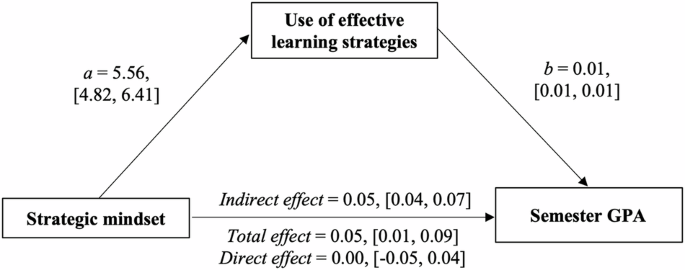
The figure represents results from a simple mediation model. The model shows the relation between students’ strategic mindset and their 5-point GPA for that same semester, mediated by their reported use of effective learning strategies. Unstandardized coefficients (represented by the small letters) and their 95% confidence intervals (in square brackets) were bootstrapped 1000 times.
Our mediation results were the same when we log-transformed students’ semester GPA (which was negatively skewed; indirect effect = 0.01, [0.01, 0.02]), and also when we controlled for students’ prior academic achievement (specifically, their college admission scores; indirect effect with college admission scores as a covariate = 0.05, [0.03, 0.07]).
Overall, college students who had more of a strategic mindset also attained higher college GPAs that semester (total effect b = 0.05 [0.01, 0.09], z = 2.62, p = 0.009). For an idea of the practical effect size, scoring 2 points higher on the 5-point strategic mindset scale corresponded to scoring an average of 0.10 higher on their 5-point GPA. This practical effect, though small, replicated in both student samples and is associated with important, objective performance outcomes.
To summarize, our field Studies 1 and 2 show that students with more of a strategic mindset tend to apply effective learning strategies to a greater extent, and consequently, achieve better academic performance. We observed this psychology across adolescents and adults, even amidst learning changes and difficulties, and also on high-stakes, nationally standardized exams. Students with more of a strategic mindset were able to learn and to perform better than their peers who had entered college at comparable levels of prior achievement. Our findings underscore that a strategic mindset predicts learning strategy use in a way that matters for real-world learning and long-term educational outcomes of importance.
Experiment 3: development and initial testing of an online intervention
In the next two experiments, we extended our correlational findings to randomized, controlled experiments (RCTs) that would allow us to test causality. Such RCTs are the gold standard for inferring causality, and they enable us to rule out alternative explanations (e.g., confounds, third variables) that may explain our correlational data35,36,37, such as a pre-existing repertoire of learning strategies or intelligence. Importantly, as part of our experimental testing, we developed online, scalable, cost-effective interventions to foster a strategic mindset that adolescents or university-level students could self-administer on their own.
Here, we developed a first strategic mindset intervention, which involved learning about the value of a strategic mindset and how to apply it. We shared with students persuasive anecdotes from the lives of highly successful people (e.g., famous athletes, businesspeople, scientists) who exemplified a strategic mindset, insights from scientific research about the importance of this mindset, and examples of how other students might apply and benefit from a strategic mindset. Students were asked to apply what they had learned in two ways: one, to write to a person close to them how that person might practice and benefit from using a strategic mindset; two, to write about how they themselves had previously applied, or were planning to apply in the future, a strategic mindset to achieve an important goal or to overcome challenges. These kinds of “saying-is-believing” exercises facilitate internalization and ownership of the intervention message, generating self-persuasion effects38,39. We present example screenshots of our intervention in Supplementary Note 2.
To establish the efficacy of our intervention approach before adapting the intervention for younger students and for in-classroom experiments, we first conducted a randomized, controlled experiment with 183 undergraduates (Mage = 21.5 years, SD = 2.3 years; 131 females, 51 males, 1 “other” gender; 164 Chinese, 11 Indian, 4 Malay, 4 “other” races) recruited from a large, public university in Singapore.
Participants were randomly assigned to either a strategic mindset condition or a control condition. Students in the strategic mindset condition received the strategic mindset intervention described earlier, whereas those in the control condition received similarly-structured messages about the value of, and how to, take breaks. The control condition was similarly structured, but did not include any strategic mindset messaging: students in the control condition also saw persuasive anecdotes from highly successful people, scientific insights, and other students’ testimonials. They also engaged in similar saying-is-believing writing exercises about the topic of taking breaks.
Finally, students answered survey questions about their attitudes toward adopting a strategic mindset, which was our manipulation check (example item: “Whenever something feels difficult, I should always ask myself: ‘What are things I can do to make myself better at this?’”; 7-point scale). Since research shows that intentions are an antecedent to behavior40, we wanted to know if self-administering the intervention would even have an effect on students’ intentions to practice a strategic mindset in the future. Students rated their future intentions to apply a strategic mindset (example item: “Whenever something feels difficult, I will ask myself what I can do to help myself get better.”; 7-point scale) as an additional outcome variable.
As our critical outcome of interest, students rated their intentions to use learning strategies that are effective for mastery over the next 2 weeks, using a prospectively-worded, abbreviated version of the LASSI Skill subscale described in Study 2 (example item: “Whenever I’m learning, I will try to find relationships between what I am learning and what I already know.”; 0–100% frequency scale). To test that our strategic mindset intervention specifically changes a strategic mindset and not a growth mindset of intelligence, we included a post-intervention growth mindset of intelligence measure (example item: “Your intelligence is something about you that you can’t change very much.”; 7-point scale).
Results showed that this initial test of the intervention was effective. Compared to the control group, students who were randomly assigned to receive the strategic mindset intervention reported stronger attitudes toward a strategic mindset (MSM = 5.9 vs. MC = 5.5, Welch’s t = 2.96, p = 0.003, Cohen’s d = 0.44), and greater intentions to apply it (MSM = 5.6 vs. MC = 5.3, Welch’s t = 2.55, p = 0.012, d = 0.37), compared to controls. Their self-reported attitudes and intentions were correlated at r = 0.44, p < 0.001. Importantly, students in the strategic mindset condition also reported greater intentions to use effective learning strategies over the subsequent 2 weeks of classes (MSM = 23.2 vs. MC = 21.9, Welch’s t = 2.00, p = 0.047, d = 0.30), compared to those in the control condition. The size of the effects on these 3 key outcomes were generally small (Cohen’s d ranged from 0.30 to 0.44), which is typical with brief, scalable social-psychological interventions and social-psychological effects in general41,42. There was no significant difference between conditions in students’ post-intervention growth mindset of intelligence beliefs (MSM = 4.3 vs. MC = 4.5, Welch’s t = 0.72, p = 0.470), indicating that the intervention specifically targets a strategic mindset. Overall, these findings gave us confidence to adapt the intervention for field testing with larger samples of students in classrooms.
Experiment 4: randomized, controlled test of a self-administered strategic mindset intervention in secondary school classrooms
Next, we adapted and experimentally tested our online strategic mindset intervention in a randomized, controlled field experiment in Secondary school classrooms. Our goals were two-fold: (1) to test whether intervening on a strategic mindset would causally impact students’ learning strategy use, and in turn, final exam performance, and (2) to understand what kinds of students it might benefit and under what conditions. This was the first test of a strategic mindset intervention for Secondary school students. If the intervention proved effective, then we would have discovered a scalable way to motivate learners’ use of effective learning strategies in the real world, through an accessible, online mode that adolescent learners can administer on their own.
As a start to understanding heterogeneity in our intervention’s effects, we tested for potential moderation by individual differences in academic preparedness and students’ perceptions of their classroom norms. These factors could, in theory, be related to the efficacy of intervening on a strategic mindset. Specifically, we used students’ prior academic achievement as a proxy of their prior academic preparedness (which we validated against their self-reported motivation to learn and their learning strategy use at baseline, pre-intervention). We measured students’ perceptions of how much their peers were engaged with the intervention. These are peer norms which reflect the conduciveness of their learning environment for engaging with the intervention, and perhaps also for learning more generally throughout the school year. By exploring such heterogeneity, our work importantly contributes toward calls in the scientific literature to better understand the conditions under which social-psychological intervention effects tend to occur, beyond simply asking whether or not main effects exist24,43.
We recruited a total of 1070 Secondary 2–4 adolescents (age range: 13–17 years; 54.1% females; further demographic details are provided in Supplementary Table 3) from 77 classes across 6 public schools that signed on to participate from the start of the academic year. Students were invited by researchers to take the online (intervention/control) exercise in their classrooms. To ensure double-blind random assignment, we used Qualtrics software to randomly assign consented students to either receive our strategic mindset intervention exercise (strategic mindset condition: N = 536) or a similarly-structured control exercise (control condition: N = 534). The online exercises were approximately 40 min in duration, and of the same length and structure. Some students (n = 475) received 1 dose about a month before their final exams (Aug–Sept), and others (n = 595) received an additional dose earlier in the year (May).
The strategic mindset intervention was inspired by, and adapted from, the intervention tested in Experiment 3 to be age-appropriate and engaging for this younger audience. We additionally sought feedback through interviews with Singapore Secondary school students to improve its design and relevance.
As an overview, the strategic mindset intervention for Secondary school students involved learning about the common challenges that Secondary school students often face; hearing other students’ testimonials about how they had used the strategic mindset psychology to overcome these challenges, to make progress, and to learn better; reading scientific evidence about effective learning; identifying strategy-eliciting questions that they themselves would find useful asking during their studies; and then committing to even more effective ways of learning for their upcoming final exams (the “Methods” section provides more detailed descriptions of the intervention; Supplementary Note 3 shows example intervention screenshots).
Importantly, we did not train students in the use of specific learning strategies, but instead focused on teaching them the value of asking themselves strategy-eliciting questions when they encountered challenges—the crux of a strategic mindset. Because of technical limitations in some Secondary schools, we chose to convey our messages using slides and interactive, open-ended questions, instead of videos.
To ensure that the control condition was exposed to a topic that was relevant and important to them, students randomly assigned to the control condition learned about the value of co-curricular activities (CCAs), and how to choose and thrive in one that fits them. Co-curricular activities include physical sports (e.g., gymnastics, badminton), clubs and societies (e.g., chess club, computer club), uniform groups (e.g., scouts, girls’ brigade), and visual and performing arts (e.g., modern dance, arts & crafts club). CCAs are a key component of students’ holistic education in Singapore and an important way for students to build socioemotional skills, physical fitness, character and moral values, a sense of belonging, friendships, and more. We kept the structure and duration of the control exercise similar to the strategic mindset intervention, but crucially excluded strategic mindset messaging from the control content.
Immediately after completing the intervention or control exercises, students answered our key manipulation check that assessed their attitude toward a strategic mindset (example item: “If students are struggling with something, they should ask themselves: ‘How else can I approach my learning to be even more effective?’”; 7-point scale). These questions were embedded among other filler survey questions to minimize demand effects.
We measured our theorized mediator (students’ reported use of learning strategies known to be effective for learning) shortly after their final exams at the end of the school year. Using the LASSI Skill subscale previously described in Study 1, students reported what effective learning strategies they had used when studying for their final exams. As our performance outcome measure and with students’ consent, we obtained their final exam performance from their schools at the end of the school year.
To analyze possible heterogeneity of our intervention effects, we assessed students’ prior academic preparedness by obtaining their prior year’s academic performance scores. To validate this, students rated their academic motivation (using the LASSI Will 5-point subscale; example item: “Even if I am having difficulty in a subject, I can motivate myself to complete the work.”) and their use of learning strategies (using the LASSI Skill 5-point subscale described earlier) pre-intervention. Students also reported their perceptions of classroom peer norms regarding engagement with the intervention (survey item: “Consider the students around you. How many students would you say were working carefully and quietly on this activity today?”; 5-point scale, where 1=Fewer than half of students and 5=All students).
In our main analyses, we used mixed effects models including random effects for education level and school, as well as class nested within level and class nested within school. This is because school exams were consistently designed and administered across all classes within each education level, and it did not make sense for us to estimate fixed effects of school given the small number of schools.
First, our manipulation of a strategic mindset was effective. Students randomly assigned to the strategic mindset condition reported, on average, more positive attitudes toward adopting a strategic mindset after the intervention, compared to students assigned to the control condition (b = 0.12, t = 2.12, p = 0.035). This result suggests that the intervention message was persuasive. Students’ attitudes toward a strategic mindset (assessed 1 month prior to their final exams) positively predicted their final exam scores (b = 0.14, t = 5.58, p < 0.001), supporting the predictive value of our manipulation check measure.
We tested our pre-registered hypotheses: first, that intervening on a strategic mindset would increase students’ use of effective learning strategies; and second, that students’ randomly assigned condition (strategic mindset vs. control) would affect their final exam performance, mediated through increased use of effective learning strategies.
However, at pre-intervention baseline, the average prior year academic performance of students who were randomly assigned to the strategic mindset condition was significantly lower than that of students in the control condition (b = −0.84, t = −2.15, p = 0.032). Because of this imbalanced randomization, we could not simply conduct our analyses as originally pre-registered. Instead, we included prior year’s academic performance as a covariate to account for this imbalance.
Contrary to our first hypothesis, we did not find an effect of condition on students’ reported use of effective learning strategies, controlling for prior year’s academic performance, p = 0.429. However, this was qualified by a significant interaction with their prior performance (interaction b = 0.19, t = 2.56, p = 0.011). Students who performed 1 standard deviation (SD) above the mean the year before significantly benefitted from receiving the strategic mindset intervention (simple effect b = 1.68, t = 2.35, p = 0.019); whereas students who performed at the mean or 1 SD below the mean did not perform significantly differently from the control condition (simple effects ps > 0.180). Figure 3 visually presents this interaction.

The figure illustrates the Condition X Prior Year’s Performance interaction on students’ reported use of effective learning strategies when studying for their final exams. The intervention significantly benefitted students who performed at +1 SD above the mean on prior year performance, but the difference was not statistically significant for those who scored at the mean or at −1 SD below the mean on prior performance.
Next, we tested our psychological process model, which is that students’ strategic mindset would impact exam performance through their use of learning strategies. Since we found a significant moderation by prior performance (where higher performing students who received the intervention reported using more effective learning strategies), we conducted a moderated mediation test, using the Process function in R (model 833) with 1000 bootstrap resamples. To test if the mediation would be significant for higher-performing students, we specified a Condition X Prior Performance interaction predicting students’ use effective learning strategies and their final exam performance. Indeed, we found evidence of moderated mediation, with students’ use of effective learning strategies as a mediator of the relation between condition and final exam performance, and prior performance as a moderator (index of bootstrapped moderated mediation = 0.02 [0.004, 0.04]).
In practical terms, we observed the theorized, significant indirect effect pathway at higher (but not lower) levels of prior performance, suggesting that more (but not less) academically prepared students seem to benefit from this strategic mindset intervention. For instance, if we take an averaged prior exam performance of 70 percentage points (which corresponds to an “A” in the Singapore education system), we find a significant indirect effect of 0.19 [0.01, 0.40]. These students in the intervention condition reported applying more effective learning strategies when studying, and consequently, performing even better on their final exams. As mentioned, the mediation was not significant at lower levels of prior performance.
How might we understand this result? The strategic mindset intervention taught students to ask themselves strategy-eliciting questions, but did not train students in using the specific strategies. Perhaps students who already had an existing repertoire of study strategies could provide useful answers when asking strategic mindset questions. Another possibility is that students who were more motivated to learn and perform well regularly practiced this strategic mindset, which might have been necessary to snowball a brief intervention into effects on their final exams a month later44. Indeed, pre-intervention, the students in our sample who had higher prior performance reported already using effective learning strategies to a greater degree (correlation with prior performance: r = 0.23, p < 0.001) and were more academically motivated (r = 0.39, p < 0.001). Thus, it is possible that this particular instantiation of a strategic mindset intervention for adolescents speaks to and benefits students who tend to be more academically prepared.
Additionally, we found that perceived peer norms around engaging with the intervention also significantly moderated the psychological process (index of moderated mediation = 0.32 [0.03, 0.62]), even when controlling for prior performance (index of moderated mediation with covariate = 0.12 [0.01, 0.25]). On average, students rated high levels of peer engagement during the intervention (M = 3.60, SD = 1.21, mode = 5.0). This suggests that, on average, most to all students in each participating class were working carefully and quietly on their respective intervention or control exercises. As we might expect, the intervention was more effective when students perceived a higher percentage of their peers to be actively engaged with it. There was a significant indirect effect pathway at higher (but not lower) levels of peer engagement. For example, among students who reported perceiving that all other students in their classes were engaged during the study session (average rating of 5.0 on a 5-point scale), we observed a significant indirect effect of 0.57 [0.04, 1.13]. These treated students in conducive peer environments reported applying more effective learning strategies when studying, and consequently, performed better on their final exams. However, the mediation was not statistically significant at lower levels of perceived peer norms.
Overall, we found that this first instantiation of a strategic mindset intervention for adolescents seemed to benefit students who were more academically prepared as well as those in conducive classroom environments with high levels of perceived peer engagement during the study session.
Although we did not pre-register tests for moderation by dosage (i.e., whether students received only 1 session of the strategic mindset intervention or 2 sessions of it), we tested for this in exploratory, secondary analyses. We did not find statistically significant three-way interactions of Condition X Prior Performance X Dosage predicting either students’ learning strategy use (p = 0.081) or final exam performance (p = 0.578). Therefore, at least in the current study, we cannot conclude that increasing the dosage from one to two sessions has any significant effect on our main outcome variables.
link