HPU Students Conduct Compelling Summer Research with Faculty | Business
HIGH POINT, N.C., July 14, 2025 – High Point University’s labs are buzzing during the summer with students and faculty collaborating on innovative research through three unique programs.
Students from every academic school are participating in these programs, which they applied for during the spring semester. The programs are SuRPS (Summer Research Programs in the Sciences), SuRF (Summer Research Fellowship) and SuRI (Summer Research Initiative). Each program pairs students with professors who guide them through projects in a variety of fields. These research projects provide students with a range of opportunities, from learning new lab technology to working together as a team.
Dehydration, Creatine and Brain Injury

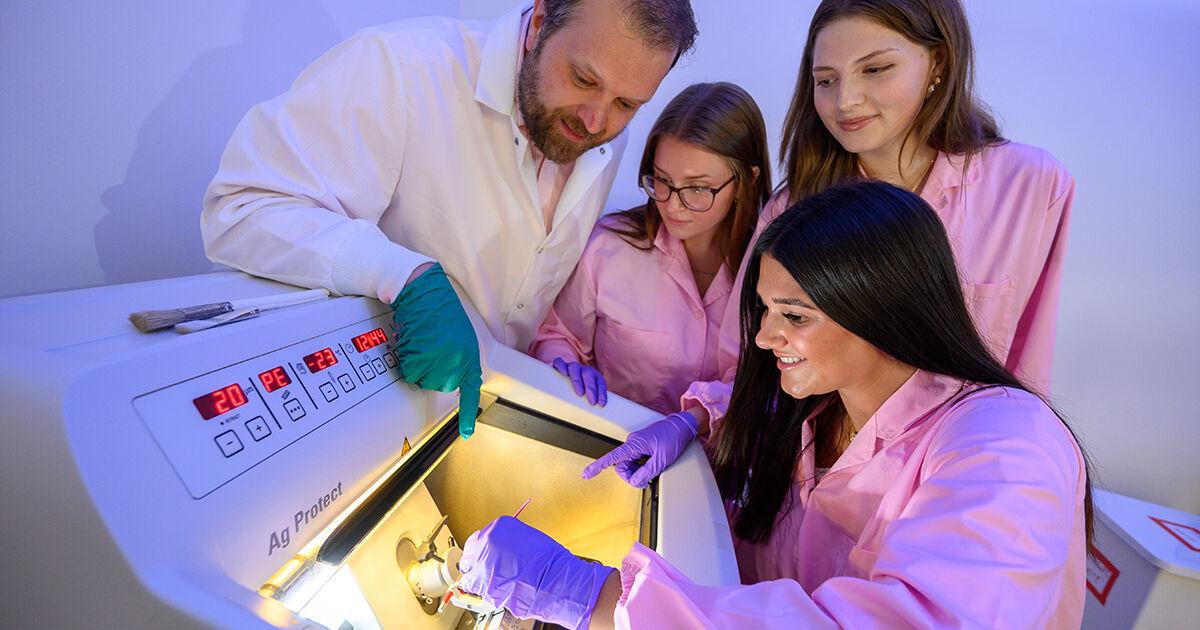
High Point University’s labs are buzzing during the summer with students and faculty collaborating on innovative research on a variety of topics through three unique programs. Dr. Bill Kochen, professor and founding chair of neuroscience, observe lab results with Harlie Culbreth, center, Isabella Frankovic and Alexandra Shutters, front.
Three students said it has been an invaluable experience for them to work in a Wanek School of Natural Sciences lab with Dr. Bill Kochen, professor and founding chair of neuroscience, to investigate the effects of dehydration and creatine on mild Traumatic Brain Injury (mTBI), also known as concussions.
Before a fight, martial artists and other combat athletes often dehydrate themselves to quickly lose weight. Shortly after weigh-ins, these athletes regularly suffer concussions during their matches. In addition, many athletes include creatine supplements in their training to boost performance. Kochen’s research with his students explores whether dehydration or creatine use before injury can change how a concussion affects an athlete.

From left, HPU students Harlie Culbreth, Alexandra Shutters and Isabella Frankovic display models of the human brain in the lab where they are researching dehydration, creatine and mild Traumatic Brain Injury.
“This eight-week program really does show students what science is like — the good days and the days you are here for 10 hours just for your assay to not work,” Kochen said. “If every experiment always worked, we would not need science; we could just guess. This summer’s research is the crash course. They are really seeing what the life of a scientist is like.”
For Isabella Frankovic, a rising sophomore majoring in neurobiology and chemistry, the project has been both transformative and a meaningful step toward her long-term goals. She plans to pursue a neuroscience MD/Ph.D. and combine clinical practice with research.

Sophomore biology majors Tyler Janick and Jordan Havert work in the lab researching fungi with Shauna Skow, a senior biology major.
“My aspiration is to become a physician-scientist, so having this kind of experience early on is instrumental,” said Frankovic, who is from Ellicott City, Maryland. “It has helped me build the foundation to investigate complex questions about the brain and has pushed me to develop so many practical skills. I have learned how to design experiments thoughtfully, work collaboratively and communicate effectively, skills I know will be essential in my academic and professional career.”
Alexandra Shutters, a junior neuroscience major, credits this experience with fueling her passion for scientific discovery and solidifying her goal of pursuing a Ph.D. in neuroscience. Throughout the program, she has learned proper lab etiquette and deepened her academic interests while gaining beneficial experience in a laboratory setting.
“We certainly learned how to have innovative perspectives,” said Shutters, who is from La Plata, Maryland. “Leading complex research as undergraduate students is rare in comparison to other programs across the country. Not only will I become a competitive applicant, but I will already have the tools to succeed once I move forward with higher education.”
Harlie Culbreth, a rising sophomore majoring in neurobiology with a minor in chemistry, is also deeply engaged in the research and thinks it will help her achieve her aspirations to attend medical school and become a neurosurgeon.
“We have been learning how to break down scientific research, figure out the most important parts and connect it to what we’re doing,” said Culbreth, who is from Henderson, North Carolina. “The goal is to take what we find and make it useful for future studies with nonhuman primates and eventually for people. Developing these skills has been so helpful, not just for this project but for my future, too. Being able to understand and use research will be crucial in medical school and later as a neurosurgeon.”
Survival in Space Beyond Earth
Three pre-dental students are working this summer in a lab with Dr. Grace Hamilton, assistant professor of biochemistry, to research microorganisms with extremotolerant genes that could be engineered to support human life off earth.
The Hamilton lab uses fungi to explore many questions in cell biology and human health. They have also recently received a grant from the North Carolina Biotechnology Center to research fungi that could help humanity survive in space. NASA researchers have proposed using these fungi to synthesize food and pharmaceuticals off-planet and even to grow habitats for human habitation. But few organisms stand any chance of surviving the harsh conditions that exist beyond earth. Polyextremotolerant fungi (PEF) are an exception.
Hamilton’s lab is identifying the specific genes that PEF use to survive in the harshest conditions on earth, laying the foundations for life on another planet.
Sophomore biology majors Jordan Havert and Tyler Janick are researching libraries of freshwater and marine fungi and screening them for production of medically useful compounds. Shauna Skow, a senior biology major, is studying how fungi control their cell shape.
“I was looking into SuRPS labs, and Dr. Hamilton’s stood out for me the most because it fit perfectly with my curriculum. I was in genetics class at the time, and I am dealing with genetic code of fungi right now,” said Havert, who is from Johnson City, Tennessee. “This is really like building blocks for me. I am finding my interest in fungus specifically, and I want to see if I can apply it to dentistry and see if I can build off that for future research.”
This is the first hands-on, professional lab experience for both Havert and Janick, who is from Quakertown, Pennsylvania.
“I learned a lot of critical thinking and problem-solving first. However, the most applicable for dental school is hands-on dexterity practice – working with my hands,” Janick said. “It’s highly specialized for dentistry, and there is a crossover with fungi and bacteria in the same realm because biofilms end up on your teeth. I’m fortunate to be in the position here in this lab. It’s clear that you can put what you learn in a textbook into practice at High Point University.”
Skow gained experience with lab techniques while working with Hamilton in her biochemistry class and lab during her junior year.
“You learn from reading your textbook, but when you get to use your skills from lab, you get to see the application of everything,” said Skow, who is from Lynchburg, Virginia. “Honestly, the coolest part is applying dilutions from genetics, general chemistry and biochemistry all coming together for these experiments.”
Hamilton’s undergraduate students are doing all the research, she said.
“Working with fungi over the summer, these students are conducting experiments that aim to discover new treatments for human diseases, answer fundamental questions in cell biology and lay the groundwork for life beyond earth,” Hamilton said.
Setting the Circadian Clock

Sierra Werner, a sophomore biochemistry major, uses a pipette to research proteins alongside Dr. Alexander Mosier, an assistant professor of biology, and student Kal Hyun Burgess-Hicks in the lab.
Two HPU students are working in the lab with Dr. Alexander Mosier, an assistant professor of biology, to continue his research of the circadian clock, which regulates an organism’s internal patterns related to 24-hour time periods and is synchronized with solar time. Both students said they are gaining foundational research skills that could help them achieve their goal of someday working as physicians.
“I’m definitely learning how to cooperate with people in a scientific field, especially when we’re doing work on a project in the same little row,” said Kal Hyun Burgess-Hicks, a 14-year-old senior biology major. “Also, I’m learning certain biological techniques and how to manage both large and small laboratories at the same time. We’re covering a lot of Western blotting and will be doing mass spectrometry when the results are in.”
His goal is to become a neurosurgeon, said Burgess-Hicks, who is from the city of High Point.
“The human brain was one of the biggest things that led me to biology because it’s one of the undiscovered organs in the human body,” he said. “I want to be part of the team that figures out more of the higher levels of what is going on here, especially in terms of neurodegenerative disease like Alzheimer’s and Parkinson’s. This research relates well to these because Alzheimer’s is correlated to disruptions in the circadian clock.”
Sierra Werner, a sophomore biochemistry major, believes working in the Mosier lab will help her achieve her goal of attending medical school.
“I’m excited to learn more about the research side of academia and science,” said Werner, who is from Stafford, Virginia. “Up until this point, I just focused on medicine. I did my EMT and sports medicine in high school, but I really wanted to explore the research side, whether I continue wanting to go to med school or if I want this as a career.”
Mosier’s research is in many ways a continuation of last summer’s work but with some slight differences. Last summer, he and his students were getting the lab started, troubleshooting equipment and designing protocols.
The circadian clock itself is the same with all organisms, so the goal would be to see how disruptions occur and what they might be impacting. The researchers could eventually look at humans to determine the ways that these disruptions relate to different diseases and ailments that people have.
“This year, we are taking that foundational work and looking at different proteins and systems that Kal and Sierra are interested in,” Mosier said. “Having students working with me over the summer is important for two main reasons. The first is a type of hands-on and focused research experience that very few undergraduates get. I think getting a more realistic view of how research works in graduate school, industry or professional life, is a wonderful experience for them. Second, it is a great time for me to work with the students more and develop projects with fewer distractions than during the school year.”
In the lab, Burgess-Hicks is focused on developing a computational modeling program that can look at how functions of quantum mechanics may impact or regulate the core circadian clock, Mosier said. Werner is looking into how interactions with the core clock help to regulate and direct additional functions of the cell, such as cell division, metabolism or protein modifications.
Physical Therapy Benefits for Golf Swings

Kennady Milligan, a sophomore exercise science major, is seated as she analyzes golf swings on a computer. Behind her from left are Dr. Don Goss, associate professor of physical therapy; Abby Capps, a first-year physical therapy student; Zach Swift, a Class of 2026 doctor of physical therapy candidate; and Westyn Woodard, a junior biology major.
Two undergraduate students are comparing the knee health of golfers with and without a history of surgery in the Human Biomechanics and Physiology Lab (HBAPL) with Dr. Don Goss, professor of physical therapy. Thirty-three people hit 30 golf balls each, providing 990 swings for analysis in the HBAPL.
Westyn Woodard, a junior biology major, learned more analysis skills by participating in the SuRF program. He already had some familiarity in the lab by participating in a research project that HPU’s chemistry department conducted during the academic year.
“We are creating 3D models based on footage of golfers to analyze how to prevent injuries,” said Woodard, who is from Lake Lure, North Carolina.
The experience of conducting research in general is important for Kennady Milligan, a sophomore exercise science major.

Westyn Woodard, left, observes Abby Capps’ golf swing in the HPU Golf Simulator, with Kennady Milligan and Dr. Don Goss
“What we’ve been doing is analyzing the golf swing simulator and labeling the markers to complete the 3D model,” said Milligan, who is from Angier, North Carolina.
Preliminary results show that golfers who have had knee surgery generally don’t do as well with golf swings or walking because of factors such as arthritis, Goss said.
“We have force plates so we can measure how hard you’re pushing on the ground to generate power,” Goss said. “If your knees hurt, you’re probably going to keep your knees bent and try to do more upper body movement and not twist – so less power, distance, efficiency and maybe more pain.”
A graduate student is also working with Goss to compare a personal warmup versus one with manual physical therapy and analyze how each affects the golf club swing, ball distance and smash factor (ratio of club head hitting the ball).

Phoenix Ward, a sophomore exercise science major, demonstrates eye-tracking goggles used this summer in HPU’s Virtual Reality and Gait Analysis Lab with Dr. Lisa Zukowski, associate professor of physical therapy, holding the focus circle target for research subjects.
Zach Swift, a Class of 2026 doctor of physical therapy candidate, worked with 20 research subjects who have participated in the study since last fall.
“Ever since then, we’ve been chipping away at it,” said Swift, who is from Reedville, Virginia. Although the research was incomplete, the physical therapy warmup provided improvement as he had predicted “so everything’s in the green.”
Aging and Alzheimer’s Disease
Phoenix Ward, a sophomore exercise science major on the pre-med track, is working this summer in HPU’s Virtual Reality and Gait Analysis Lab with Dr. Lisa Zukowski, associate professor of physical therapy. They are focused on identifying things that help or hinder optimal aging in older adults.
“I do a lot of work with cognition, visual attention, how someone is walking through an environment and how all those things interact to either help or hinder somebody as they perform complex everyday tasks,” Zukowski said. “This was part of a longitudinal study done over a 30-month period in conjunction with the Wake Forest University School of Medicine to understand how healthy older adults are aging.”
Part of what they are researching involves collecting data from tracking the eyes of research subjects who are wearing goggles as they attempt to perform a task. They must navigate their way through an obstacle-filled environment while doing the task. Ward also will analyze eye-tracking data from a task that individuals were asked to perform while grocery shopping.
“I have learned how to properly find articles and about the different language used in this type of research,” said Ward, who is from Brooklyn, New York. “I’m looking to either go to med school, physical therapy or physician assistant school. I just wanted to get exposed to different areas of health sciences. This was a great opportunity and a productive use of summer to get started on research.”
Some results of this study funded by the National Institutes of Health already have been presented at national and international conferences, Zukowski said. Research participants had no cognitive impairment, but imaging scans revealed that some individuals in this group had neurodegenerative signs that indicated an elevated risk of developing Alzheimer’s Disease. Research participants came to Zukowski’s lab for analyses of complex cognitively demanding tasks, which inhibit someone’s ability to compensate for and hide subtle deficits.
“The overall goal is a better understanding of how changes in the brain impact how somebody functionally does things,” Zukowski said. “Some people will have a lot of neurodegeneration and never develop Alzheimer’s Disease; other people will have very little and then develop Alzheimer’s Disease. It’s not a purely linear relationship. We need to better understand this relationship and what roles compensatory behaviors play in order to develop targeted interventions to delay the onset or progression of the disease.”
Tracking Musical Acoustics

Dr. Eric Rokni, assistant professor of physics, works on musical acoustics research with physics majors Josh Elbertson, center, and Zachary Ready.
Three physics students are exploring the interdisciplinary field of acoustics this summer with Dr. Eric Rokni, assistant professor of physics. Their research delves into the physics of musical instruments, focusing on phenomena such as phantom partials, which are produced by piano strings. Ongoing research aims to expand this understanding to other instruments, including the cello, guitar and banjo.
Rokni’s work is ideal for students interested in the intersection of physics, engineering and applied science. Students are learning to make precise sound measurements using speakers and microphones, analyze frequency data and design experimental fixtures using 3D printing and related tools.
“I am learning how to interpret signals, switching raw audio data into a power spectral density form,” said Zachary Ready, a sophomore physics and mathematics major from Henderson, Nevada.
As a cellist, Rokni was intrigued as to whether the earlier research on pianos would remain true for other stringed instruments. He is refining research he started 10 years ago for a better understanding.

Rokni and physics major Claire Klein examine banjo acoustics.
“I’ve always been interested in how this can relate to cellos, whether we see a similar phenomenon or whether this is important to consider when we are modeling these instruments and synthesizing the sounds or whether we can just ignore it,” Rokni said. “It’s still an open question that seems simple on the surface, but when you start delving into the math of it, there are some complicated mathematical equations that describe the way these instruments behave.”
Claire Klein, a sophomore physics and music major, said she appreciates the way this research bridges physics and music.
“It’s really amazing to get to do research as an undergraduate student,” said Klein, who is from Downers Grove, Illinois. “You get a personal connection here with professors, which makes learning easier.”
Expanding Nanotechnology

From left, HPU students Sara Hamidpour and Vladimir “Vovi” Lagutin work with Dr. Sean Johnson, assistant professor of electrical engineering, to continue advancing nanowire research.
HPU students Sara Hamidpour and Vladimir “Vovi” Lagutin are working in a lab with Dr. Sean Johnson, assistant professor of electrical engineering, to continue advancing nanowire research started last summer. They are taking the next steps by using an atomic force microscope and applying Complementary Metal-Oxide-Semiconductor (CMOS) technology processes.
Under Johnson’s mentorship, students of HPU’s Electrical and Computer Engineering Department have studied nanowire photo detectors and focused on developing the processes to fabricate patterned nanowires on graphene substrates that could be used on flexible electronics, which are electronic devices that can bend and twist into different shapes without breaking. This is a crucial step in extending CMOS technology to include the emerging graphene-based electronics field.
“We are studying creating a process for developing lithography methods onto graphing substrates,” Johnson said. “Specifically, graphing is a material that is very versatile, flexible, has great conductivity, is strong and can be used to build electronics. We want to build a platform that you can grow nanowires onto graphing substrates with specific placement, which hasn’t been done before.”
In the field of computer engineering, the skill of fabricating semiconductor materials would be valuable for technology companies moving forward, said Lagutin, a junior computer engineering major.
“Lithography onto graphing substrates, having never been done before, and applying research methods and learning how to use various equipment to do that, I think, would be a valuable skill to have in my arsenal,” said Lagutin, who is from Fletcher, North Carolina.
“I was curious as to how I could use my two majors, and getting to use it specifically in material science is something new to me,” said Hamidpour, a sophomore computer science and chemistry major from Greensboro, North Carolina. “I’m interested in learning more about that.”
link