Tech with purpose: South Eugene High teacher gives meaning to learning

QuickTake:
Lallie McKenzie has taught engineering technology courses at South Eugene High School for eight years, using student-directed learning as her North Star for teaching. Her new class, HumaniTech, gives students a reason to care about engineering.
Editor’s note: People are the heart of Lane County — which is why, each week, Lookout Eugene-Springfield will profile someone who is working behind the scenes to make our community better. If you have suggestions on others we should profile, send us an email.
Name: Lallie McKenzie
Age: 61
Occupation: South Eugene High School teacher
Years in role: Eight
Lallie McKenzie looked out into the room of 25 blank teenage faces.
McKenzie had just presented the task of the day for the students in her “HumaniTech” class on Nov. 12: Plan how to make an adaptive toy for a student with intellectual and developmental disabilities in their Unified Robotics club.
McKenzie’s students had already learned to wire, solder and use 3-D design software to create plastic buttons to turn devices on and off.
But this new project was a step up for the high schoolers. Helping them summon the internal motivation and creativity they would need for the project would be a challenge.
“So this is when you think like a four-year-old, OK?” she said. “You don’t question your ideas.”

HumaniTech — the name refers to the class aim of showing how technological skills can serve humanity — is a hands-on introduction to many of the fundamentals of engineering. It teaches skills that students don’t get in traditional math and science classes. And so a project like making adaptive toys and vehicles is a perfect exercise for the class — adding purpose to a learning process that requires trial, error and patience.
McKenzie’s moment of encouragement at the beginning of the Nov. 12 class is an example of her supportive teaching approach. She has become a fixture in Eugene School District 4J’s technical education classes and believes that giving students a reason to care makes learning more interesting — and impactful.
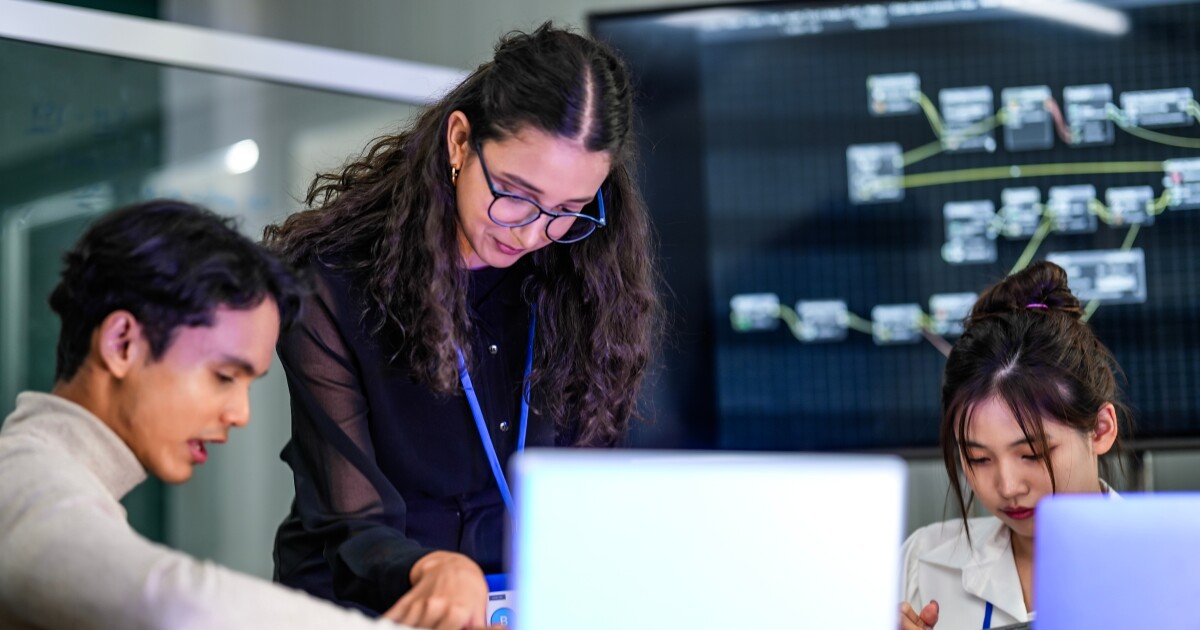
The HumaniTech classroom at South Eugene High School is spacious and bright, with tall windows that give students and teachers a view of Spencer Butte.
Students spend two periods every day in HumaniTech, earning credits in math, science and art. Any eleventh or twelfth grader in the district can take the the class through 4J’s Center for Applied Learning and Community Impact, with busing from other high schools provided. During the Nov. 12 class, some students worked independently, while others, excited about their plans, came up to McKenzie throughout the class.

Autumn Petersen, a junior, sped through the initial assignment of making a plan with her partner. She presented her idea for a red, white and blue flashing police light that could attach to her Unified Robotics student’s wheelchair. The student likes to pretend he’s the “hall monitor” on his regular trips through the halls, and Petersen thinks the playful addition would excite him.
Petersen will wire the light so that the student will be able to press the on-off button with his head. But the wiring would be a tight squeeze because of the dimensions of the light.
McKenzie, knowing that Petersen and her partner were among her advanced students, shared a workaround that would allow the light and the toy’s wiring to connect through an external receptacle, something she hadn’t yet taught the broader class.
“There’s no one way to reach every kid,” McKenzie said after the mini-lesson. “That’s where the relationship-building can be key to figuring out how one kid might learn something.”
The concept of motivation

McKenzie spent more than a decade in academia researching, teaching, developing curriculum and earning multiple degrees, including a PhD in chemistry, before deciding the high school classroom was where she belonged. She took with her not only scientific experience and knowledge but also her curiosity — in particular, a fascination with the concept of motivation.
She recently wrote two statements on the white board in her classroom: “People do well if they want to,” and “People do well if they can.”
Several of her students this year struggled with the design software when they first started learning how to use it. So she had the students do an exercise. She first asked them what they thought the school system believed: Do kids do well when they want to, or do kids do well when they can?
Most of her students said the school system believes that students fail because they don’t have the will to succeed as opposed to not having the skills to succeed.
Then she asked the students what they thought. Many said it was both: The students needed motivation to learn — but also the skills.
McKenzie started the engineering technology Career and Technical Education program at South Eugene High School eight years ago, but it’s only her second year of HumaniTech, which has students of various abilities. Because the learning curve is steep for certain skills, like using the 3-D design software, she added community service to give students a reason to master the hard stuff.
McKenzie said for some of her students who struggle with attendance, the impact of their HumaniTech projects give them a reason to come to school.
The gift of movement
One of the projects in HumaniTech is building adaptive electric jeeps for elementary-age students who use wheelchairs. Last year, class members made a jeep for a student with whom 4J physical therapist Ashlee Shupe works.
Shupe said the jeep, which is white with a yellow pineapple bubble machine attached to it, has been instrumental in her student’s growth, because it gives him the ability to explore places he couldn’t access in his wheelchair.

“I had him out at recess and he was adamant that he was taking this thing in the grass and it was very purposeful,” she said. “In his wheelchair, no one is pushing it through the grass and getting it all muddy.”
The ability to explore opens up cognitive growth and engagement with the world that kids naturally have when they can move without limits.
“It’s not just a fun thing,” Shupe said. “It really is giving more independent mobility to someone who otherwise doesn’t have that.”
Putting the human in HumaniTech
Ryan Hansen, McKenzie’s co-teacher, supervised a group of students in their second year of HumaniTech as they finished wiring on an electric jeep.
Months ago, after realizing the child they were designing the original jeep for would be too big for the vehicle, the students started working on a jeep with a larger plastic frame. But the larger one, unlike its smaller counterparts, didn’t come with an instruction manual.

The work was a true trial-and-error project from start to finish. During the Nov. 12 class period, the studens finally got the jeep to move, only to figure out that they had soldered something incorrectly. The students would have to go back a few steps to fix it.
It’s an example of how Hansen, who did his student-teaching with McKenzie, uses one of her philosophies: Let students drive their own learning.
“We don’t always have to be the expert about everything,” Hansen said. “A lot of times showing them how we approach problems and what we do when we are confused, lost or otherwise in a rough spot is something that they pick up on pretty quickly.”
Senior Ben Springer, a second-year HumaniTech student, said while he was frustrated by the soldering mistake, it showed him that there had been a communication gap along the way — something he will work to avoid in the future.
The work is challenging, Springer said, but giving kids who have limited mobility a way to move is special. He helped make a jeep during his first year of the program and the kid who received it was too shy to drive it at first. Later, in a video, Springer saw the kid’s pure joy as he drove it.
“He was doing doughnuts and they thought that he didn’t know how to drive it, but he just really liked spinning,” he said.
An uncertain future

The materials and technology needed for a hands-on class like HumaniTech are expensive.
This year, a Eugene Education Foundation grant and the Lane STEM Hub through Lane Education Service District are funding HumaniTech. Next year, McKenzie doesn’t know if they’ll get the same funding. She and Hansen are also worried about the district cutting the class due to budget shortages. The class’s enrollment grew from eight students the first year to 25 students this year, however, showing the popularity of the class — and the instructors.
Springer values the personal connection he has with McKenzie. She’s also a mentor on his robotics team, which means they see each other a lot. His experiences in HumaniTech and in robotics have cemented Springer’s interest in the engineering field.
“Talking to the teacher in this class is completely different than other classes,” Springer said. “It’s less like I’m talking to this person who controls my future, and more like I’m talking to someone who is invested and wants to help me with the future.”
Clarification: This story has been updated to include information about HumaniTech being open to all eleventh and twelfth graders in the 4J.
link